
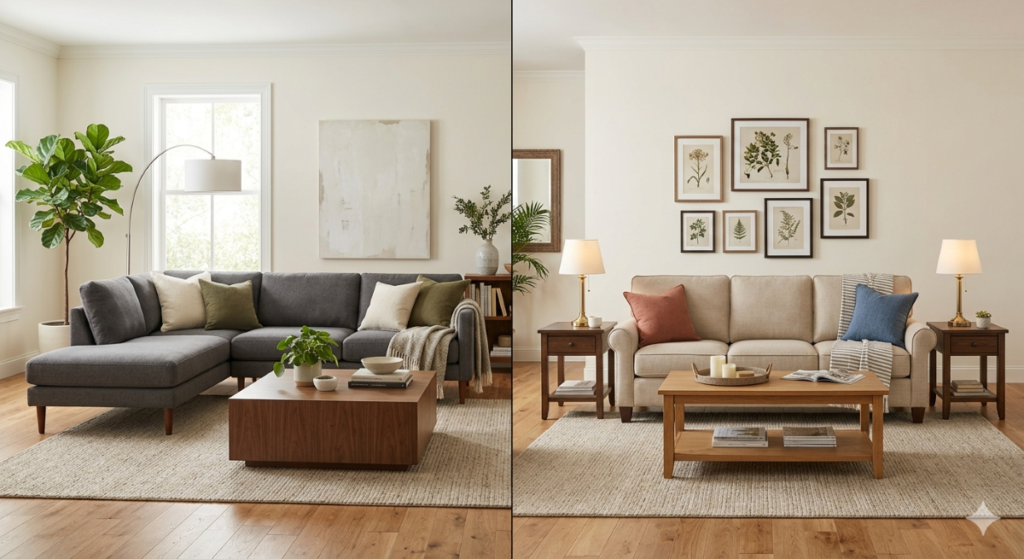
A sectional is best for larger rooms, open floor plans, and households that gather in groups. A standalone sofa works better in smaller rooms, formal spaces, conversation-driven layouts, and homes with quirky shapes or architectural features. The right choice almost always comes down to how you actually live in the room, not how the room looks in photos.
If you’re shopping for a sectional sofa in Raleigh, NC, you’re already thinking about how the seating will define the space. That’s the right instinct. A sofa or sectional is the largest visual and functional anchor in most living rooms, and the wrong choice creates daily friction. Here’s how to think it through.
Before you choose between a sectional and a sofa, look at the room with fresh eyes. Where does the light come in? Where are the doorways? Is there a fireplace, a built-in, or a feature wall that wants to stay visible? How does foot traffic move through the space?
A sectional is a wall of fabric. It anchors a corner or defines an edge. That’s a strength in a great room where you need to mark off the seating area, and a weakness in a long, narrow room where it blocks the path from the kitchen to the back door. A standalone sofa is more flexible. You can angle it, float it in the middle of the space, or pair it with chairs to balance a focal point.
Triangle homes break across this divide pretty cleanly. Older inside-the-Beltline homes (Five Points, Hayes Barton, Cameron Park, Boylan Heights) tend to have rectangular rooms with traditional proportions and multiple entry points. They usually do better with a sofa-and-chair or two-sofa arrangement that leaves walking paths open. New construction in Wake Forest, Apex, Cary, and Hasentree often features open great rooms where the sectional earns its keep, defining the seating area within a much larger space.
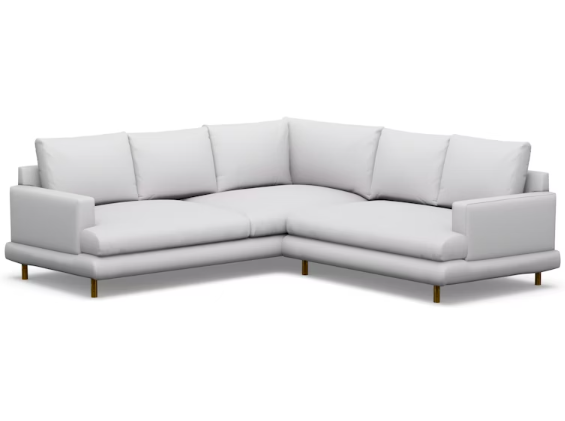
A sectional makes sense when several of these are true. Your room is large or open, with high ceilings and long sightlines that can feel empty around a single sofa. You host a crowd often, since sectionals hold more people comfortably than a sofa-and-loveseat combination. You actually use the chaise for naps, reading, or movies. The room needs definition in an open-concept floor plan where a sectional draws a clear line around the seating zone.
The classic sectional pitfall is buying one for a room that can’t quite hold it. As Livingetc points out in their sectional vs. sofa breakdown, a sectional has to fit not just the floor space but the doorways, hallways, and turns it has to clear during delivery. Measure twice, and don’t forget the door diagonal.

A sofa makes sense when any of these apply. Your room is small, narrow, or shaped oddly: sectionals demand boxy rectangular spaces, and older Raleigh homes with bay windows, fireplaces, built-ins, or angled walls almost always do better with a flexible arrangement. You want the space to feel formal or layered: a sofa with two flanking chairs reads as more polished and creates better conversation flow. You rearrange furniture often: sofas are easier to angle, float, or move. You entertain in a way that needs conversation: sectionals seat more people, but make eye contact awkward. You have multiple living spaces: if a basement or family room can hold the sectional, the formal living room benefits from staying flexible.
A sofa-and-chair arrangement is also more space-efficient per seat than people realize. Two sofas in an L-shape can seat six adults comfortably with better proximity for conversation, while a comparable sectional often seats three or four with one stuck in the corner.
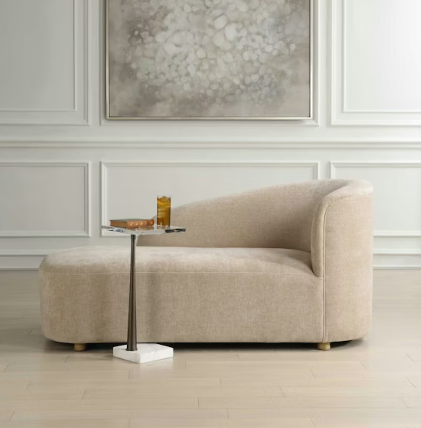
This is the in-between option that confuses a lot of people. A sofa with an attached chaise (sometimes called a “chaise sofa”) is technically a small sectional. It gives you a stretch-out seat without committing to the size or shape of a true L- or U-shaped piece.
It’s a strong choice for medium-sized rooms where a full sectional would feel oversized but a single sofa would feel underscaled. It works well in apartments, smaller family rooms, and condo living rooms in places like North Hills or downtown Raleigh. The chaise side has to be specified left or right, so make sure it’s on the side of the room where you’ll actually use it (usually the side with the best view or the spot away from the main traffic path).
When clients can’t decide between a sectional and a sofa, these questions usually surface the answer:
How do you watch TV at night? If everyone piles up together, sectional. If people sit on different pieces of furniture, such as a sofa.
How often do guests stay over? A sectional with a chaise or sleeper component handles overnight guests easily. A formal sofa-and-chair setup doesn’t.
Do you have kids or pets? Both work, but sectionals tolerate the chaos of a busy family room better than a tailored sofa, especially if you’re choosing between fabric and leather. A loose-cushion sectional in performance fabric is essentially indestructible.
How long do you plan to stay in this house? If you’re settled, a sectional sized to the room is a great long-term investment. If you might move in five years, a sofa is more likely to fit your next house.
What’s the room actually for? A casual family room and a formal living room call for different answers, even within the same home. A surprising number of Triangle homeowners end up with one of each.
Whichever direction you go, the measurements are the same conversation. A sofa should occupy roughly two-thirds of the wall it sits against. A sectional should leave at least 30 to 36 inches of walkway around it on the open side. Coffee tables sit 14 to 18 inches from the seat front.
For most Raleigh living rooms, the magic numbers look like this: a 12 to 14 foot wall accommodates an 84 to 96 inch sofa. A 14 to 16 foot wall accommodates a 96 to 108 inch sofa or a small L-shaped sectional. A truly open great room (16+ feet of wall and no immediate doorway interruption) opens up the larger sectional configurations.
The biggest reason this decision feels stressful is that off-the-floor options force you to choose between two imperfect fits. A custom sofa or sectional sidesteps the dilemma. You can size a sectional to fit a room that an off-the-rack model would overwhelm. You can adjust seat depth, arm height, and leg style to match the proportions of your home. You can have a sectional that’s small enough for a downtown condo or a sofa long enough for a Wake Forest great room.
Furnish carries Norwalk Furniture sectionals and Norwalk sofas, both customizable to your dimensions, fabric, and finish. Our designers can walk you through the trade-offs in person, or you can start by browsing our living room sofa collection to see what’s possible.
If you’re earlier in the process and still working through the broader buying decisions (style, fabric, frame construction, lead time), the full custom sofa buyer’s guide covers the rest of the picture. The seating decision is a big one, but it’s only one of several worth thinking through before you order.