
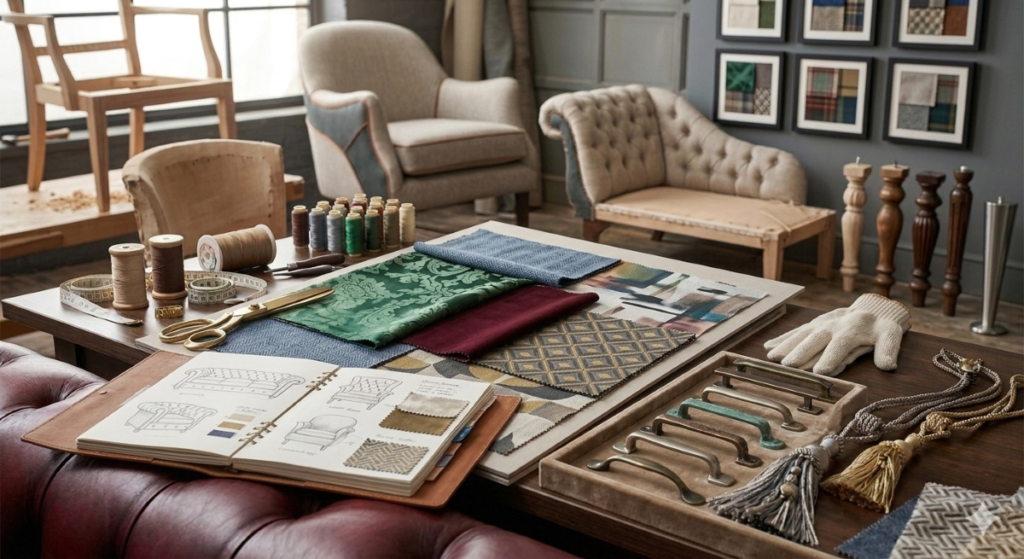
Custom upholstery is furniture built to your specifications after you order it, with your choice of fabric, frame, dimensions, and finishing details. It costs more than off-the-floor furniture (typically 20% to 50% more for comparable styles) and is usually worth the difference because the construction quality, fabric options, and longevity are meaningfully better. The break-even point for most buyers comes between years five and seven, when off-the-rack pieces start to sag, and custom pieces still look new.
Searching for “custom built furniture near me” tends to produce a confusing mix of results, from upholstery shops that reupholster existing pieces to retailers that offer mild customization on stock frames. This guide explains what real custom upholstery is, what’s actually under the fabric, and how to think about the cost versus an in-stock piece.
The phrase covers a range, and it pays to know where on the spectrum a piece sits.
Fully custom means the maker builds the frame after you order it, in dimensions and configuration you specify, with fabric and details you choose from their library. Lead times typically run 8 to 16 weeks. American makers, including Norwalk, Hickory Chair, Lee Industries, and others, operate this way for most of their lines.
Customizable stock means the frame design is fixed, but you can choose fabric, leg style, cushion fill, and sometimes minor details. Lead times are shorter (often 4 to 10 weeks). This is more common at mass-market retailers.
Made-to-order is a marketing term that can mean either of the above. It’s worth asking a showroom specifically what’s customizable about a piece before assuming.
The North Carolina furniture industry has historically built much of its identity around this kind of work. The state still has more than 850 manufacturers, and the makers who survived the offshoring waves of the 2000s did so largely by leaning into custom upholstery, where craftsmanship justifies a domestic price tag. The High Point furniture industry sits about ninety minutes west of Raleigh and remains the largest concentration of furniture-making expertise in the country.
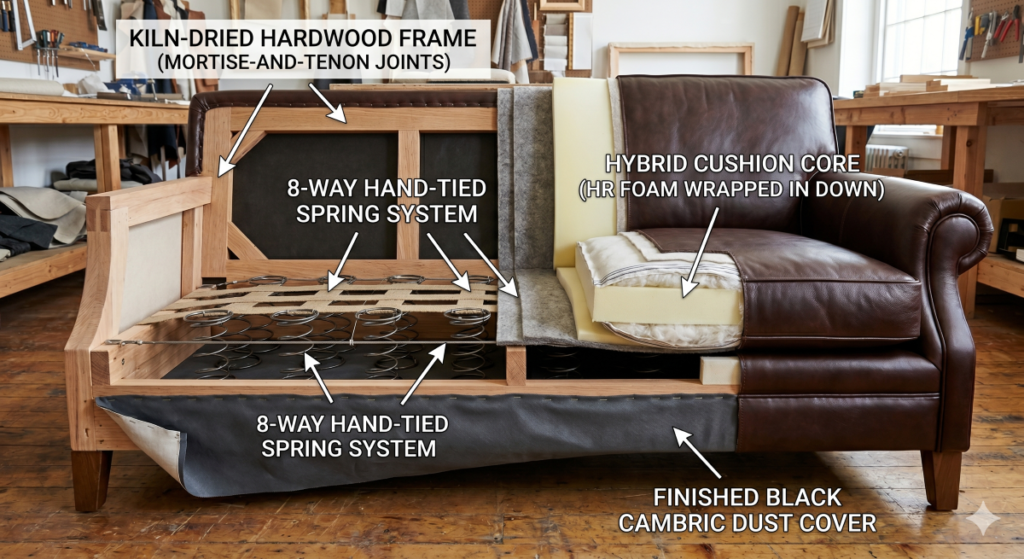
The price difference between a $1,200 sofa and a $4,000 sofa is mostly hidden under the fabric. A few things to look for:
Beyond the construction differences, custom changes a few practical things.
For a fuller breakdown of what’s customizable and how those choices affect the feel of a piece, our custom sofa buyer’s guide walks through the decision tree.
Custom upholstery typically costs 20% to 50% more than a comparable off-the-floor piece from a mid-tier retailer. Quality custom sofas start around $2,500 to $3,500 and move up from there.
The case for paying more rests on three factors.
Where custom upholstery isn’t worth it: starter apartments, temporary rentals, basement guest rooms, or any space you’ll only use occasionally. Save the investment for the rooms you actually live in.
The pattern we see most often: custom solves a fit problem that off-the-rack can’t. A young family in Cary is replacing a national-chain sectional that sagged within three years. A couple downsizing from a Hayes Barton home into a North Hills condo with a wall length that no standard sofa fits. A homeowner in Wake Forest with two large dogs who wanted a light-colored sofa anyway and needed real performance fabric to make it work. Style preference alone doesn’t always justify the cost. A real fit problem (size, fabric, lifestyle, durability) almost always does.
Some retailers use the word “custom” loosely. Four questions separate genuine custom upholstery from light customization on a stock frame: Where is the frame manufactured? (Real custom is built domestically after you order it. Frames built in Asia and shipped to a U.S. warehouse are stocked with a fabric choice.) What’s the lead time? (True custom runs 8 to 16 weeks. A 1-to-2-week lead time is standard with fabric selection.) How many fabrics are offered? (Hundreds means real custom. A handful means in-stock fabric.) Can you change dimensions? (If seat depth, length, and back height are fixed, it isn’t really custom.)
If you’re searching for “custom built furniture near me” from a Raleigh address, the shortlist is mostly retailers selling American-made upholstery from North Carolina, Virginia, Tennessee, Pennsylvania, and Ohio makers. Custom upholstery requires a domestic supply chain to operate at reasonable lead times. Importers can’t build custom pieces and ship them on the same timeline.
That alignment between “custom” and “American-made” is part of why we focus on makers like Norwalk, which builds in its employee-owned Ohio factory. Browse our custom furniture options or Norwalk’s full catalog to see what we mean. If you’ve read our older post on what custom-made furniture is, this article extends that picture with a deeper look at upholstery construction.
The question of whether custom is worth it is really a question of how much the room matters to you. For occasional use, no. For the room where you actually live, almost always yes.