
To measure for a new sofa, take three sets of numbers: the room itself (length, width, ceiling height), the wall and floor space where the sofa will sit, and the path from your front door to that spot, including doorway widths, hallway turns, and stairwell clearances. The single most important measurement is the door diagonal, which tells you whether the sofa can actually fit through the entry tilted on its side.
Measuring sounds boring, and most people skip the careful version. Then the delivery team shows up with a beautiful piece of living room furniture, in Raleigh, NC, traffic that took twenty minutes longer than expected, only to find the sofa won’t clear the front door. This guide is the hour you spend up front, so that doesn’t happen.
Start with the room as a whole. You’re trying to understand what scale of furniture the space can hold without feeling cramped or empty.
Wall length where the sofa will sit. A common rule is that the sofa should be roughly two-thirds the length of the wall, leaving breathing room on either side. For a 12-foot wall, that’s about 96 inches. For a 14-foot wall, around 108 inches.
Room depth. Measure from the wall where the sofa will sit to the opposite wall (or the edge of the seating area in an open-plan space). You’ll need at least 30 to 36 inches of walkway behind or alongside the sofa for traffic flow.
Ceiling height. Most rooms accommodate any standard sofa, but ceiling height affects how a sofa reads visually. Lower ceilings (8 feet or less) feel oppressive with a tall-back tufted sofa. High ceilings (10+ feet) can swallow a low-profile mid-century piece.
Existing fixtures. Note window heights, fireplace position, doorway swings, HVAC vents, and outlets. These constrain where the sofa can sit even when the wall length seems generous.
Houzz designers recommend thinking through the room as a series of relationships between pieces, not isolated measurements. A sofa that’s the right size for the wall might still be wrong for the way the room functions, so the next step is just as important.
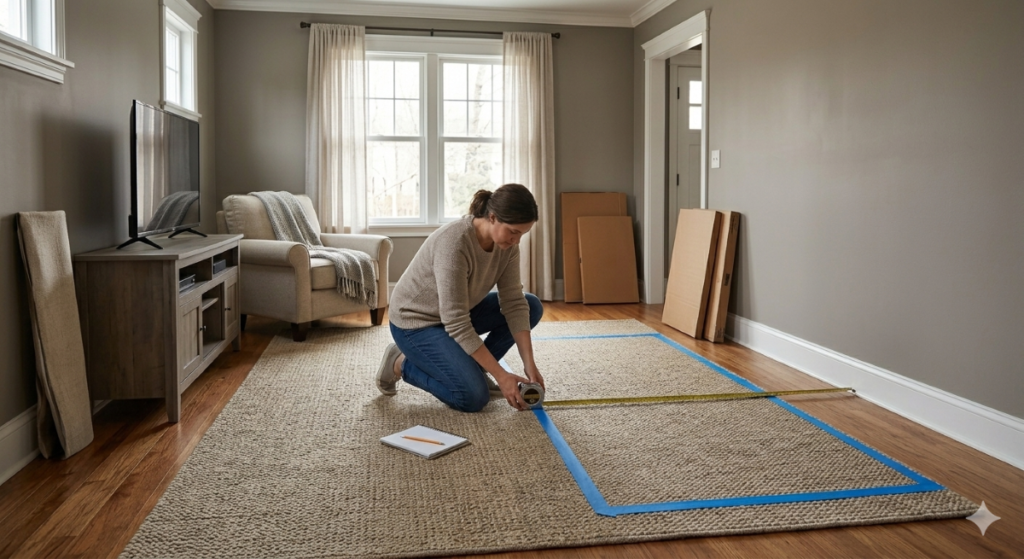
Before you order anything, mark the sofa’s footprint directly on your floor with painter’s tape. This is the single best way to test scale.
Use the dimensions of the sofa you’re considering. Tape a rectangle of the exact length and depth on the floor. Walk around it. Try sitting where the front edge would be. Stand a chair behind where the back would sit. Note where it hits relative to the windows, the fireplace, the doorways, and any rugs you already own.
You’ll catch problems on the floor that no online tool can predict: a sofa that blocks a path to the kitchen, an end table that won’t fit beside it, a coffee table relationship that feels wrong, a back height that interferes with a low window.
For a sectional, tape both the long arm and the chaise return. The combined footprint is what matters, and most sectional buyers underestimate how much floor space the chaise eats.
Living rooms feel cramped when the clearances are wrong, even if the sofa technically fits. A few common rules:
Behind the sofa or alongside it (main walkway): 30 to 36 inches minimum. Between the sofa and a coffee table: 14 to 18 inches. Between two sofas facing each other: 6 to 8 feet (this is the conversation distance most designers favor). Between a sofa and a TV wall: 1.5 to 2.5 times the diagonal of the screen for comfortable viewing.
If your taped footprint doesn’t leave these clearances, the sofa is too big for the room. Don’t talk yourself into it. A smaller sofa that breathes will look better and live better than a bigger sofa that fills every inch.
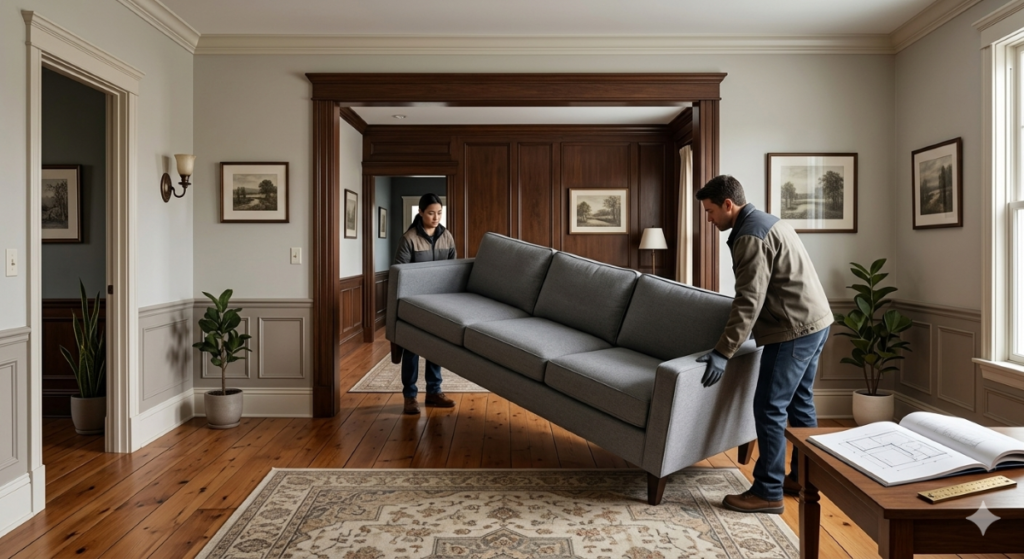
This is the measurement nobody talks about and everyone should. A sofa is rarely delivered upright through a door. It’s tilted, sometimes turned diagonally to clear the frame. The clearance you actually need depends on the diagonal depth of the sofa and the diagonal of your doorway.
Measure the height and width of your front door, then calculate the diagonal: square the height, square the width, add them, and take the square root. (For a 36-inch wide, 80-inch tall door, that’s about 87.5 inches diagonal.) Compare to the sofa’s diagonal depth (the manufacturer should list it). If the door diagonal is smaller, the sofa won’t fit, no matter how much the delivery team angles it.
For Raleigh homes, this is most often a problem in older inside-the-Beltline houses with narrow doorways and tight foyers, and in walk-up condos where stairwells limit clearance. Some manufacturers offer sofas with detachable arms or legs to help. Norwalk Furniture, for example, builds many frames with knock-down construction that lets the sofa come apart for delivery and reassemble in your room. Ask about this if your home has a difficult entry.
Once the sofa clears your front door, it still has to reach the room. Walk the path from the entry to the final spot and look for hallway turns (a 90-degree turn in a narrow hallway can be harder than the door), stairwells (especially turning stairs in townhouses around North Hills, downtown Raleigh, or Cary), banisters at the top of a stair, light fixtures and arches, and tight kitchens or breakfast nooks the sofa has to pass through. When the path is questionable, ask about white-glove delivery. A skilled team can navigate most homes, but they won’t perform miracles for sofas that are physically too large.
Older Raleigh homes have charm and quirks. Bay windows and turret rooms (common in Hayes Barton, Cameron Park, and Five Points) eat up wall length and can interrupt sofa placement. Built-in bookcases and millwork (Cameron Village, Budleigh, parts of Forest Hills) work best when the sofa aligns visually rather than fighting them. Sloped ceilings in Cape Cod and bungalow attic conversions in Five Points and Mordecai limit sofa back height. Corner fireplaces in 1960s and 1970s ranches make seating arrangements a puzzle. Open-plan great rooms in newer Wake Forest, Apex, Holly Springs, and Hasentree construction need a sofa that anchors the seating area without blocking the kitchen sightline (low-back sectionals work especially well).
If your home falls into any of these categories, custom sizing matters more than usual. Off-the-rack sofas come in a handful of standard lengths. Custom can be sized within a quarter inch of what your room actually needs.
Before you visit a showroom, write down:
Bring all of it. A showroom team that has these numbers can guide you in two minutes to options that will fit. A team without them is guessing.
Once the measurements are done, the rest of the process gets easier. You can rule out frames that are too long, too deep, or too tall. You can size sectionals confidently. You can ask the right questions about delivery.
The full picture (style, fabric, frame, lead time, what to ask) is in our custom sofa buyer’s guide. If you’re still on the fence about whether you need a sofa or a sectional, our sectional vs. sofa breakdown covers the trade-offs.
When you’re ready, our designers at Furnish help Raleigh homeowners measure, plan, and customize living room furniture and Norwalk sectionals that fit the actual rooms in actual Triangle homes. Bring the tape measure numbers. We’ll handle the rest.